Documentary
Showing posts with label art. Show all posts
Saturday, October 28, 2017
Monday, October 23, 2017
San Jose State University Screening of Art and Revolutions
Screening of Art and Revolutions PLUS a traveling exhibition on Posada and the Penny Press!
Date and Time:
Thursday 12/7/17, 5:00pm-6:00pm
Art Lecture Hall, Room #133
Department of Art & Art History
San José State University
Located on 9th Street Plaza, SJSU Campus, San José, CA 95112
http://www.sjsu.edu/map/
LINK Below:
http://events.ha.sjsu.edu/art/events/documentary-screening-searching-posada-art-revolutions/
Date and Time:
Thursday 12/7/17, 5:00pm-6:00pm
Art Lecture Hall, Room #133
Department of Art & Art History
San José State University
Located on 9th Street Plaza, SJSU Campus, San José, CA 95112
http://www.sjsu.edu/map/
LINK Below:
http://events.ha.sjsu.edu/art/events/documentary-screening-searching-posada-art-revolutions/
Saturday, October 3, 2015
Monday, December 9, 2013
"Searching for Posada" Lecture at The Mexican Museum, San Francisco, CA December 14, 2013
|
Monday, September 3, 2012
Happy Birthday to La Catrina (1912-2013), Jose Guadalupe Posada's Most Famous Calavera
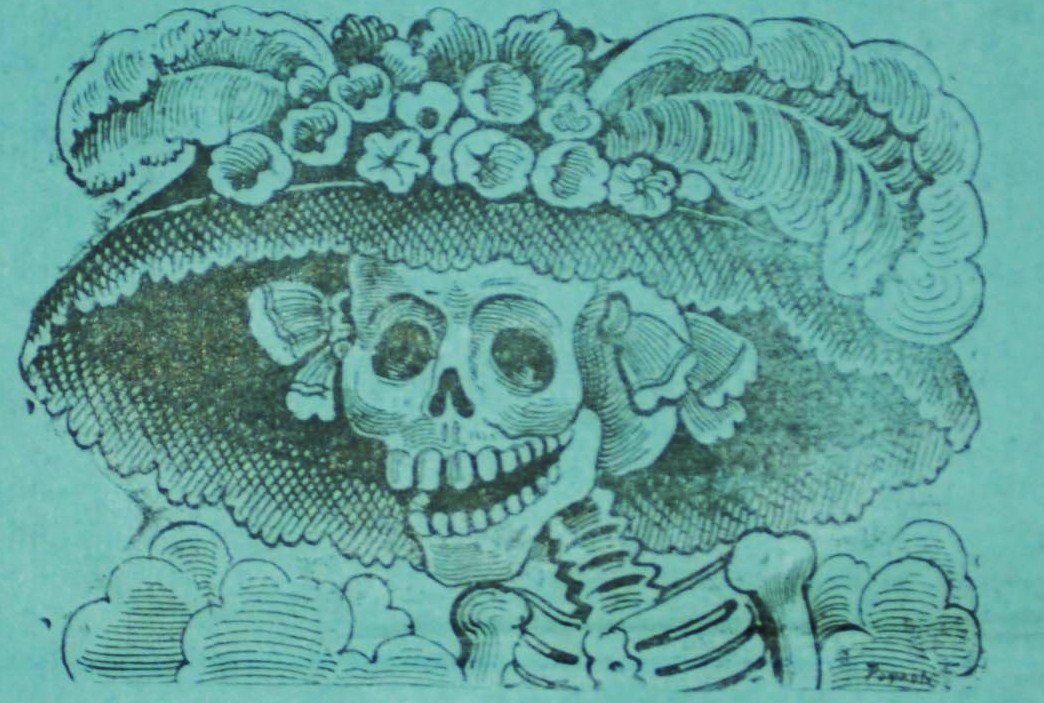
Perhaps the most famous image that Posada created seen here is known today as La Calavera Catrina, which is the feminine of the Catrin or male dandy. The current year of 2012 marks the 100th anniversary of her first appearance in the publications of Antonio Vanegas Arroyo. Posada never illustrated her in any form other than as she appears here. As far as we know she appeared first in November of 1912, a mere three months before Posada died in January of 1913. But the popular image has since been portrayed countless times in full length. This credit perhaps goes to Diego Rivera who created a full-length version La Catrina in honor of Posada in his mural at the Hotel del Prado in Mexico City.
Friday, August 3, 2012
Museo Posada, Aguascalientes, Mexico
José Guadalupe Posada was born in Aguascalientes, Mexico in 1852. During the 61 years of his life until his death in 1913 he would great a legacy of artistic genius and ultimately become one of the most influencial artists in the history of Mexico let alone the world.
A visit to the museum and the beautiful state of Aguascalientes provides the visitor with an opportunity to see Posada's original engravings and hundreds of images made while in the employ of Antonio Vanegas Arroyo. It is a journey well worth the trip!
http://www.aguascalientes.gob.mx/temas/cultura/espacios/museos/m_posada.aspx
A visit to the museum and the beautiful state of Aguascalientes provides the visitor with an opportunity to see Posada's original engravings and hundreds of images made while in the employ of Antonio Vanegas Arroyo. It is a journey well worth the trip!
http://www.aguascalientes.gob.mx/temas/cultura/espacios/museos/m_posada.aspx
Sunday, June 10, 2012
Jose Guadalupe Posada and Sensational Press Images
"Very Interesting News" reads the 1910 headline about the sensational story of Antonio Sanchez who goes berserk with an axe killing his parents, wife and infant son. He then eats his son! The image communicates the horror of the event in no uncertain terms. If Sanchez did devour his son, any question of what it might have looked like is resolved with this image. Although it is unsigned it was likely drawn by Posada and certainly approved by Antonio Vanegas Arroyo. We believe it serves as an excellent example of Vanegas Arroyo's sensational practices and also indicative of the collaborative nature of their relationship. Who directed the body parts with bodies strewn about, the bulging eyes and mad look of Sanchez? Then there is the baby being eaten, not chopped up into bits but eaten whole, perhaps while alive! The shear grotesque look and terror of the image helps to reinforce the moralistic aspects of the story line, which ultimately is warning the reader not to gamble. Sanchez loses all he has gambling and when his father refuses to pay his debt, the tragedy ensues. Eventually Sanchez is apprehended, tried, convicted and put to death. His body is then destroyed by natural elements. It seems justice must be served. Posada throws in some diablitios "little devils" perhaps to show how the devil is around to lead us astray. There are many examples of such sensational images in Posada and Vanegas Arroyo's collaborative work. In Posada's day images could be constructed to portray events or emphasize certain points. Now days we have color photographs and film, digital and immediate appearing via Internet or satellite broadcast but the fundamental sensational elements used by Vanegas Arroyo and Posada are the same that we use today.
Wednesday, May 30, 2012
Monografia: Jose Guadalupe Posada
Published in 1930, the Posada Monografia was the first major publication devoted to Posada's work. The publisher was Francis Toor of Mexican Folkways and it was really a collaboration of many artists of the time.
In addition to Francis Toor, Paul O'Higgins (aka Pablo Esteban O'Higgins, b. 03/01/1904 - d. 07/16/1983) pulled prints from the original plates that were at the Vanegas Arroyo Publishing house. Blas and his son Arsacio were running the printing house in those days. Diego Rivera wrote a short forward for the publication and Jean Charlot was also involved. This publication helped bring Posada's name into the spotlight and in many ways could be considered the defining work that allowed many people to see for the first time who the artist was that created so many of the images that had appeared in dozens of publications in Mexico from about 1872 and even after Posada's death in 1913.
Saturday, May 26, 2012
Mexico's Taller de Gráfica Popular, Jose Guadalupe Posada and Today's Art
This lithograph image by José Chávez Morado (1909-2002), a member of the Taller de Gráfica Popular (TGP), entitled: “LA RISA DEL PUEBLA.” Con su música a otra parte. [“The laughter of the people.” With its music elsewhere, Mexico City, 1939], is an example of the quality of the art generated by the TGP. Jose Guadalupe Posada began his career as a lithographer and later shifted his efforts to engravings and etchings. The TGP formed to utilize art toward communicating social causes of their time. Posada was a major influence on their work whether it was lithography or engraving. There is a path to the art of today that runs from Posada through the TGP. Along the way there are many artists, publishers and historians who have contributed to what we see in contemporary art collectives and the imagery of social movements. We will post many examples of these images/connections in the future.
Sunday, May 13, 2012
The Dollar Battles the Peso-- Touché!
This timeless political cartoon was published as a halfsheet broadside by A. Vanegas Arroyo and was used several times by the publishing house as an illustration accompanied by text looking at the battle of the US dollar and the Mexican peso (the peso as far as this illustration goes is winning). Unsigned but attributed to Posada it needs few words, utilizing humor and creative expression to communicate the story. As a testimony to the collaboration of the two men, the cartoon is as relevant today as it was when it appeared over 100 years ago.
Monday, April 30, 2012
Mexican Folkways, Frances Toor, Anita Brenner and Jose Guadalupe Posada
Pictured here is the front cover of Mexican Folkways which was a Mexico City based magazine published from 1925-1937. The magazine was bi-lingual in Spanish and English. Its founder/publisher was Frances Toor(b.1890- d.1956), an American woman and anthropolgist who in 1922 came to study in Mexico City and essentially made Mexico her home. Diego Rivera, became the magazine's art editor in 1926 and in this 1928 edition we see cover art by Rivera but more importantly inside is the first significant article about Jose Guadalupe Posada. It is written by author Anita Brenner (b. 1905 - d. 1974), born in Aguascalientes, Mexico which was also the birthplace of Posada. The article appearing in this edition of Mexican Folkways would later be incorporated into Brenner's 1929 book, Idols Behind Altars. These publications set the stage for the first comprehesive collection of Posada's works, Monografia, that would be published in 1930 by Frances Toor and Mexican Folkways.
Tuesday, April 10, 2012
The Earliest Reference to Posada and Vanegas Arroyo
One of the first people to publish a reference about Jose Guadalupe Posada and Antonio Vanegas Arroyo was Mexican painter, printmaker, writer and some say also a volcanologist, Gerardo Murillo (Jalisco, Guadalajara, b. 1875 - d. 1964). He signed his works as "Dr. Atl" (atl = the Nahuatl word for water). Pictured here is the front cover to the two volume set of Los Artes Populares de Mexico published in 1922; five years after the death of Antonio Vanegas Arroyo and nine years after the death of Posada. In the second volume Dr. Atl briefly reviews printmaking and aspects of literature such as songs, religious works and what might be called "tabloid-like" publications of Mexico. The publishing house of Vanegas Arroyo is discussed and grabador "Guadalupe Posadas" is very briefly mentioned; significantly, the printing house is described as one of the leading printing establishments of it kind and for the time. A variety of Posada's images are pictured in the volume, some of the engravings/etchings are signed by Posada and some unassigned images are also reproduced.
Wednesday, December 8, 2010
Mexican Gameboards by Jose Guadalupe Posada

Posada illustrated at least a dozen gameboards for the Vanegas Arroyo printing house. This particular game called Juego de la Oca or Game of the Goose may have originated in Europe but as seen in this version is believed to have appeared in Mexico during the 1880s. There are 63 little boxes, dice were rolled and pieces advanced (and sometimes turned back) with the winning objective to be the first to land in the Garden of the Goose. The print of this gameboard was made with an acid etching and signed by Posada. It is still played in Mexico to this day.
Saturday, December 4, 2010
Aztec Images and Jose Guadalupe Posada's Calaveras

In this image of a stone carving from the Museo de Antropologie in Mexico City we see some of the historical evidence from which Posada gathered inspiration for his calaveras. Hundreds if not thousands of such examples exist but the interesting thing is that calavera images really did not become "popular" until Posada's illustrations of calaveras were put out into the world through the printing press of Antonio Vanegas Arroyo. Artist Jean Chalot drew attention to Posada beginning in the 1920s-1930s and today with the popularization of calavera images Posada is growing beyond Mexican roots and into the global sphere. Fortunately, the only papers Posada's calaveras need are the papers they are printed on!
Subscribe to:
Posts (Atom)

